
Have you ever wondered exactly how many weeks are in a year? While most of us casually think of a year as “12 months,” translating that into weeks can be surprisingly useful for planning, budgeting, or even tracking fitness goals. In this article, we’ll break down the numbers, explain the difference in leap years, and give you tips for making the most of your weeks.
How Many Weeks Are in a Standard Year?
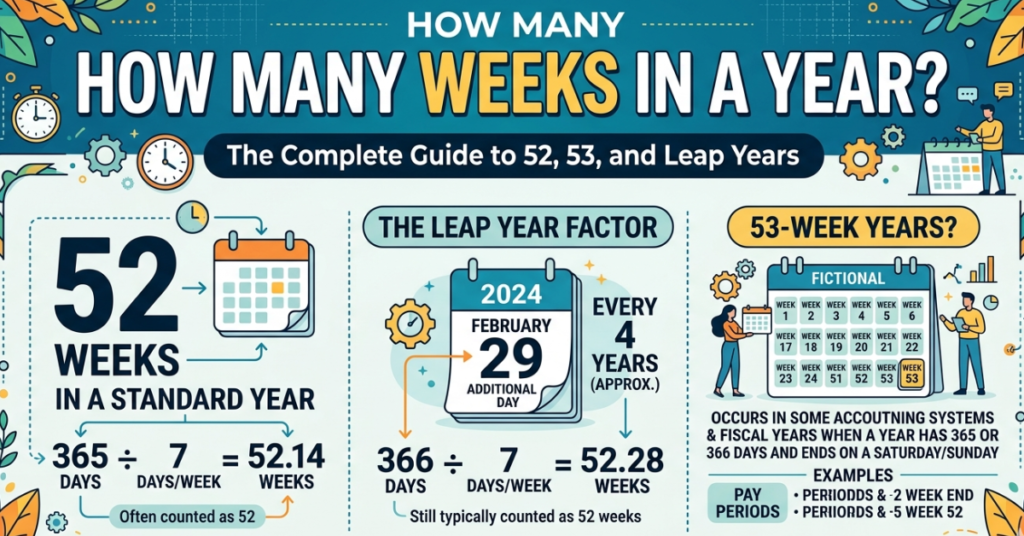
A standard year has 365 days. Since a week has 7 days, we can calculate the number of weeks like this:
365÷7=52 weeks and 1 day365 \div 7 = 52 \text{ weeks and 1 day}
So, in a typical year, there are 52 full weeks plus an extra day. That extra day is why calendars don’t always align perfectly from year to year.
Key takeaway: Most people think of a year as 52 weeks, but it’s slightly more than that.
What About Leap Years?
Leap years have 366 days instead of 365, which occurs every 4 years to keep our calendar aligned with the Earth’s orbit around the Sun.
366÷7=52 weeks and 2 days366 \div 7 = 52 \text{ weeks and 2 days}
So, in a leap year, you still get 52 complete weeks, but with two extra days added.
Tip: These extra days are why birthdays and holidays shift weekdays from year to year.
Breaking Down a Year by Weeks
Here’s a simple overview of how a year looks in weeks:
- Standard year: 52 weeks + 1 day
- Leap year: 52 weeks + 2 days
- Months to weeks: Most months have about 4 weeks, but some months have 30 or 31 days, creating extra days beyond 4 weeks.
| Month | Approximate Weeks | Extra Days |
| January | 4 | 3 |
| February | 4 | 0 (or 1 in leap year) |
| March | 4 | 3 |
| April | 4 | 2 |
| May | 4 | 3 |
| June | 4 | 2 |
| July | 4 | 3 |
| August | 4 | 3 |
| September | 4 | 2 |
| October | 4 | 3 |
| November | 4 | 2 |
| December | 4 | 3 |
This table makes it easy to visualize how weeks accumulate over the year.
Why Knowing Weeks Matters
Understanding the number of weeks in a year is more than trivia—it can help you:
- Plan your work schedule or vacations efficiently
- Track fitness or study goals weekly
- Budget monthly and weekly finances
- Calculate deadlines for projects or contracts
FAQs About Weeks in a Year
Q1: Are there always exactly 52 weeks in a year?
No, a year has 52 full weeks plus 1 extra day (or 2 in leap years).
Q2: How many weeks in a leap year?
A leap year has 52 weeks and 2 days.
Q3: How do extra days affect calendars?
The extra day(s) cause holidays and birthdays to move forward by one or two weekdays each year.
Q4: Can a year have 53 weeks?
Yes, in rare cases depending on how the first day of the year falls. If January 1st is a Thursday in a standard year, the year will have 53 weeks according to ISO week numbering.
Conclusion
In summary, a typical year has 52 weeks and 1 day, while a leap year has 52 weeks and 2 days. Knowing this helps with planning, organizing schedules, and understanding calendar quirks. Next time you plan your goals, think in weeks—it’s a practical way to manage your time effectively.