
Taxes show up in everyday purchases, but not all taxes work the same way. If you’ve ever wondered how is an excise tax different from a sales tax, you’re not alone. These two types of taxes often appear on receipts, yet they serve different purposes and are applied in distinct ways.
Understanding the difference helps you make sense of pricing, government revenue, and even policy decisions. In this guide, we’ll break it all down in simple terms, using real-world examples and practical explanations.
What Is a Sales Tax?
A sales tax is a percentage-based tax applied to the purchase price of goods and sometimes services. It’s usually added at checkout and clearly shown on your receipt.
Key Features of Sales Tax
- Charged as a percentage of the purchase price
- Added at the point of sale
- Paid directly by consumers
- Collected by retailers, then passed to the government
- Often varies by state, region, or country
Example of Sales Tax
If you buy a pair of shoes for $100 and the sales tax is 8%, you pay:
- Price: $100
- Sales tax: $8
- Total: $108
Simple and transparent — you see it right away.
What Is an Excise Tax?
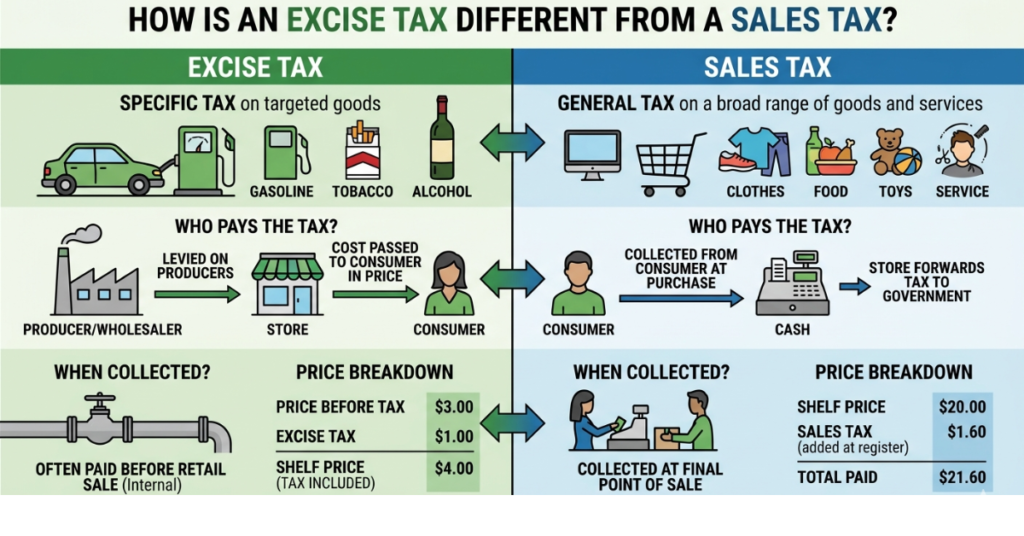
An excise tax is a tax placed on specific goods, services, or activities. Instead of being a percentage of the total price, it’s often a fixed amount or included in the product’s cost.
Excise taxes are commonly applied to:
- Fuel (gasoline and diesel)
- Tobacco products
- Alcohol
- Airline tickets
- Luxury goods
- Environmental-impact items
These taxes are usually built into the price, meaning you might not see them separately.
Example of Excise Tax
When you buy gasoline:
- The price per gallon already includes federal and state excise taxes.
- You don’t see the tax broken down at checkout.
How Is an Excise Tax Different From a Sales Tax?
Here’s a clear comparison to highlight the main differences:
| Feature | Excise Tax | Sales Tax |
| Applied To | Specific goods/services | Most retail purchases |
| Calculation | Fixed amount or percentage | Percentage of price |
| Visibility | Often hidden in price | Usually shown on receipt |
| Purpose | Discourage use or raise targeted revenue | General government funding |
| Who Pays | Often manufacturers/importers (passed to consumers) | Consumers directly |
| Example | Gasoline tax | Retail store tax |
Why Governments Use Excise Taxes
Governments use excise taxes for several reasons:
1. Discourage Certain Behaviors
Excise taxes often target goods considered harmful, like:
- Cigarettes
- Alcohol
- Sugary drinks
Higher prices can reduce consumption.
2. Fund Specific Programs
Revenue from excise taxes may fund:
- Road maintenance (fuel tax)
- Healthcare programs (tobacco tax)
- Environmental initiatives
3. Target Luxury Spending
Some excise taxes apply to luxury items to generate revenue from higher-income consumers.
Why Sales Taxes Are Used
Sales taxes are more general and predictable. Governments use them to:
- Fund public services
- Support education
- Maintain infrastructure
- Balance budgets
They apply broadly, which makes them a reliable revenue source.
Excise Tax vs Sales Tax: Real-Life Examples
Let’s look at everyday scenarios:
Example 1: Buying Gas
- Includes excise tax in the price
- May also include sales tax in some regions
Example 2: Buying a Phone
- No excise tax (usually)
- Sales tax added at checkout
Example 3: Buying Cigarettes
- Excise tax included in price
- Sales tax added separately
- Result: double taxation effect
Key Differences at a Glance
Here’s a quick summary:
Excise Tax
- Product-specific
- Often hidden
- Sometimes fixed per unit
- Used to discourage consumption
Sales Tax
- Broadly applied
- Visible at checkout
- Percentage-based
- Used for general revenue
How These Taxes Affect Consumers
Understanding how an excise tax is different from a sales tax helps you recognize:
- Why gas prices fluctuate
- Why cigarettes are expensive
- Why checkout totals change
- How taxes influence behavior
Excise taxes influence what you buy, while sales taxes affect how much you pay overall.
FAQs
1. Is an excise tax included in the price?
Yes, excise taxes are usually built into the product price and not shown separately.
2. Is sales tax always shown on receipts?
Most of the time, yes. Sales tax is typically listed as a separate line item.
3. Can a product have both excise tax and sales tax?
Yes. Products like alcohol, tobacco, and fuel often have both.
4. Who pays excise tax?
Technically, manufacturers or importers pay it first, but the cost is passed to consumers.
5. Which tax is higher, excise or sales tax?
It depends on the product. Excise taxes on items like cigarettes can be very high.
6. Are excise taxes federal or state?
They can be both. Many items have federal and state excise taxes combined.
Conclusion
So, how is an excise tax different from a sales tax? The main difference lies in how and where they’re applied. Excise taxes target specific goods and are often hidden in prices, while sales taxes apply broadly and appear at checkout.
Both play important roles in government funding, but they also influence consumer behavior in different ways. Understanding these distinctions makes you more aware of what you’re paying — and why.
If you want to deepen your knowledge, explore related topics like VAT, income tax, or indirect taxes to see the bigger picture.