
You’ve probably heard that walking 10,000 steps a day is the gold standard for staying active. But how far is 10000 steps, really? Is it a few blocks, several miles, or an all-day commitment? The answer depends on stride length, height, and walking speed—but on average, it’s more manageable than you might think.
In this guide, we’ll break down the distance, explain variations, and show how you can realistically reach this goal without turning your day upside down.
On Average, How Far Is 10,000 Steps?
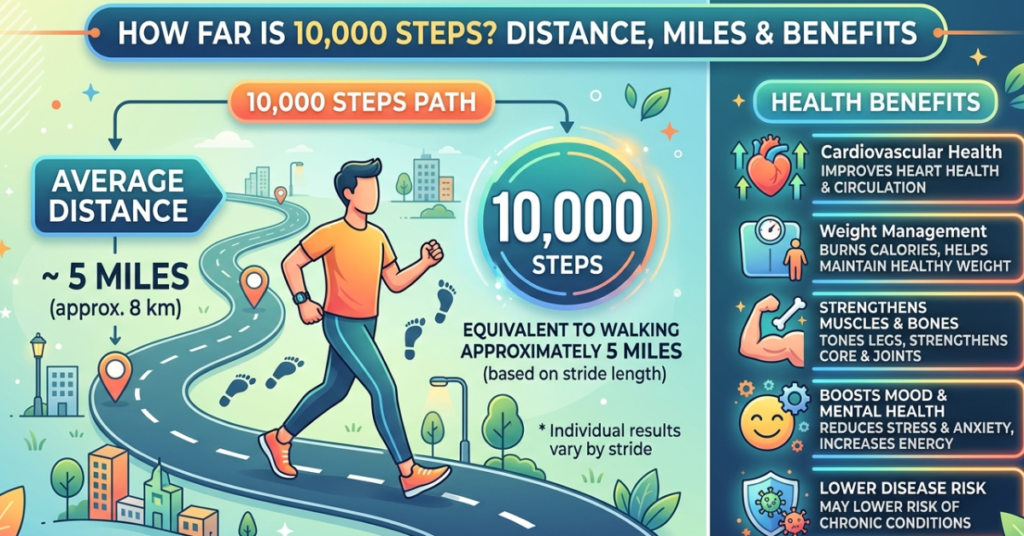
For most adults, 10,000 steps equals about 4 to 5 miles (6.4 to 8 kilometers). However, the exact distance varies based on your stride length.
Average estimates:
- Women: ~4.2 miles (6.7 km)
- Men: ~4.8 miles (7.7 km)
- Short stride: closer to 4 miles
- Long stride: closer to 5 miles
So, on average how far is 10000 steps? Roughly the distance of a long neighborhood walk or about 90–120 minutes of moderate walking.
Approximately How Far Is 10,000 Steps in Miles and Kilometers
Here’s a quick breakdown for clarity:
| Steps | Miles (Approx.) | Kilometers (Approx.) |
| 1,000 | 0.4 – 0.5 | 0.6 – 0.8 |
| 5,000 | 2 – 2.5 | 3.2 – 4 |
| 10,000 | 4 – 5 | 6.4 – 8 |
This means approximately how far is 10000 steps depends mostly on stride length, but the 4–5 mile range is a reliable benchmark.
What Affects the Distance of 10,000 Steps?
Several factors influence how far you actually travel:
1. Height and Stride Length
Taller people generally take longer steps, covering more distance.
2. Walking Speed
- Slow pace: shorter steps
- Brisk pace: longer steps
- Power walking: maximum distance
3. Terrain
Walking uphill or on uneven ground shortens stride length.
4. Fitness Trackers
Devices may calculate distance differently depending on calibration.
About How Far Is 10,000 Steps in Daily Life?
To visualize the distance, here are real-world comparisons:
- Around 80–100 minutes of walking
- Roughly 8 km city walk
- About 20 laps around a standard track
- Walking your dog multiple times daily
Breaking it up makes it easier:
- Morning walk: 3,000 steps
- Daily errands: 2,000 steps
- Afternoon stroll: 2,500 steps
- Evening walk: 2,500 steps
Total = 10,000 steps without much effort.
Health Benefits of Walking 10,000 Steps
Reaching this step count consistently offers multiple benefits:
- Improves cardiovascular health
- Supports weight management
- Boosts mood and reduces stress
- Enhances metabolism
- Improves sleep quality
Research from organizations like the CDC and Harvard Health Publishing shows that even 7,000–8,000 steps daily can reduce mortality risk—but 10,000 remains a great motivational target.
How Long Does It Take to Walk 10,000 Steps?
Depending on pace:
- Slow walk: ~120 minutes
- Moderate pace: ~100 minutes
- Brisk walk: ~80 minutes
You don’t have to do it all at once—spread throughout the day works just as well.
Easy Tips to Reach 10,000 Steps Daily
- Take phone calls while walking
- Use stairs instead of elevators
- Park farther from entrances
- Walk after meals
- Set hourly step reminders
Small changes add up quickly.
FAQs About 10,000 Steps
How far is 10,000 steps for most people?
For most adults, it’s between 4 and 5 miles, depending on stride length.
Is walking 10,000 steps a day enough exercise?
Yes, it meets general physical activity recommendations for many people.
How many calories do 10,000 steps burn?
Typically 300–500 calories, depending on weight and pace.
Can beginners start with 10,000 steps?
It’s better to start with 5,000–7,000 and gradually increase.
Why is 10,000 steps the popular goal?
The number originated from a Japanese pedometer marketing campaign but became widely adopted due to its practicality and health benefits.
Conclusion
So, how far is 10000 steps? For most people, it’s roughly 4–5 miles, or about 6.4–8 kilometers. While the exact distance varies, the key takeaway is that reaching this goal is achievable with simple lifestyle changes. Break it into smaller walks, stay consistent, and you’ll enjoy both the physical and mental benefits.