
Ever wondered how beaches turn into stone or how fossils get locked inside rocks? The answer lies in how sedimentary rocks are formed. These rocks tell the story of Earth’s past, from ancient oceans to shifting deserts.
In simple terms, sedimentary rocks form when layers of sediment — like sand, mud, and tiny rock fragments — pile up and harden over time. This process happens slowly, sometimes taking millions of years, but it’s happening all around us today.
Let’s break it down step by step so it’s easy to understand.
What Are Sedimentary Rocks?
Sedimentary rocks are rocks formed from accumulated sediments. These sediments can come from:
- Broken pieces of other rocks
- Mineral crystals
- Organic materials (like shells or plant remains)
- Chemical deposits from water
Common examples include:
- Sandstone
- Limestone
- Shale
- Conglomerate
These rocks often form in layers, which makes them easy to identify.
How Are Sedimentary Rocks Formed? Step-by-Step Process
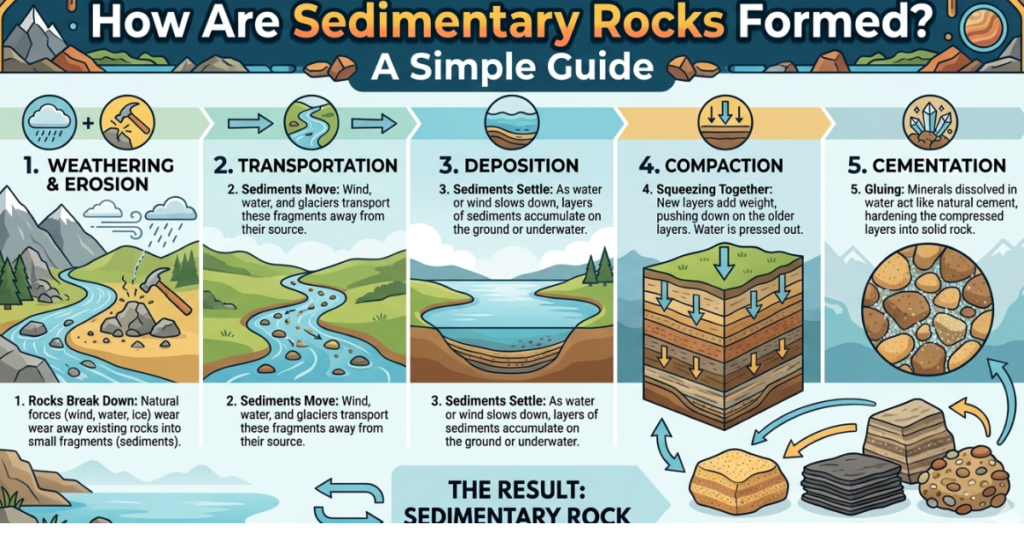
The formation of sedimentary rocks follows four main stages:
1. Weathering and Erosion
The process begins when existing rocks are broken down.
Weathering breaks rocks into smaller pieces through:
- Wind
- Rain
- Ice
- Temperature changes
Erosion then carries these particles away using:
- Rivers
- Wind
- Glaciers
- Ocean waves
This creates sediments that will eventually form new rocks.
2. Deposition
Once sediments are transported, they settle in a new location. This is called deposition.
Sediments commonly collect in:
- Rivers
- Lakes
- Oceans
- Deserts
- Deltas
Heavier particles settle first, followed by finer ones. Over time, this creates layers of sediment.
3. Compaction
As more layers build up, pressure increases. The weight of upper layers compresses the lower ones.
During compaction:
- Air and water are squeezed out
- Sediment particles move closer together
- Layers become more solid
This step is crucial in forming sedimentary rocks.
4. Cementation
Finally, minerals dissolved in water act like glue. They fill the spaces between sediment particles and cement them together.
Common natural cements include:
- Silica
- Calcite
- Iron oxide
After cementation, loose sediments become solid sedimentary rock.
Types of Sedimentary Rocks
Sedimentary rocks fall into three main categories:
Clastic Sedimentary Rocks
Formed from fragments of other rocks.
Examples:
- Sandstone
- Shale
- Conglomerate
Chemical Sedimentary Rocks
Formed when minerals crystallize from water.
Examples:
- Rock salt
- Gypsum
Organic Sedimentary Rocks
Formed from plant or animal remains.
Examples:
- Coal
- Limestone (from shells)
Why Sedimentary Rocks Are Important
Sedimentary rocks are valuable because they:
- Preserve fossils
- Reveal Earth’s history
- Store groundwater
- Contain oil and natural gas
- Provide building materials
Geologists rely heavily on sedimentary rocks to understand past environments.
Real-Life Example of Sedimentary Rock Formation
Imagine a river carrying sand into the ocean:
- Sand settles at the bottom
- More sand piles on top
- Pressure builds over thousands of years
- Minerals glue the sand together
- Sandstone forms
That’s how sedimentary rocks are formed in action.
Key Features of Sedimentary Rocks
You can often identify sedimentary rocks by:
- Visible layers
- Fossils
- Grainy texture
- Softer composition
- Rounded particles
These features help distinguish them from igneous and metamorphic rocks.
FAQs About How Sedimentary Rocks Are Formed
What is the first step in forming sedimentary rocks?
The first step is weathering and erosion, where existing rocks break down into sediments.
How long does it take for sedimentary rocks to form?
It can take thousands to millions of years, depending on pressure and environmental conditions.
Where are sedimentary rocks commonly found?
They are mostly found in riverbeds, lakes, oceans, and deserts.
Can fossils form in sedimentary rocks?
Yes! Sedimentary rocks are the most common place to find fossils because sediments bury organic material.
What is the difference between sedimentary and igneous rocks?
Sedimentary rocks form from sediments, while igneous rocks form from cooled magma or lava.
Conclusion
So, how are sedimentary rocks formed? It all comes down to four main steps: weathering, erosion, deposition, compaction, and cementation. Over time, loose sediments turn into layered rocks that record Earth’s history like pages in a book.
Understanding sedimentary rocks helps us learn about ancient climates, discover fossils, and even locate natural resources. Next time you see layered rock formations, you’ll know they took millions of years to form — one grain at a time.