
When an emergency or unexpected event occurs, incident coordination becomes the backbone of an organized response. But here’s where many people get confused: which one of the following activities is not an example of incident coordination?
Understanding the difference between coordination and other incident management activities is crucial—especially for students, safety professionals, and anyone preparing for emergency management exams. This article breaks it down in plain English, with real-world examples and easy-to-follow explanations.
By the end, you’ll clearly understand which one of the following activities is not an example of incident coordination, why it matters, and how to identify it quickly.
What Is Incident Coordination?
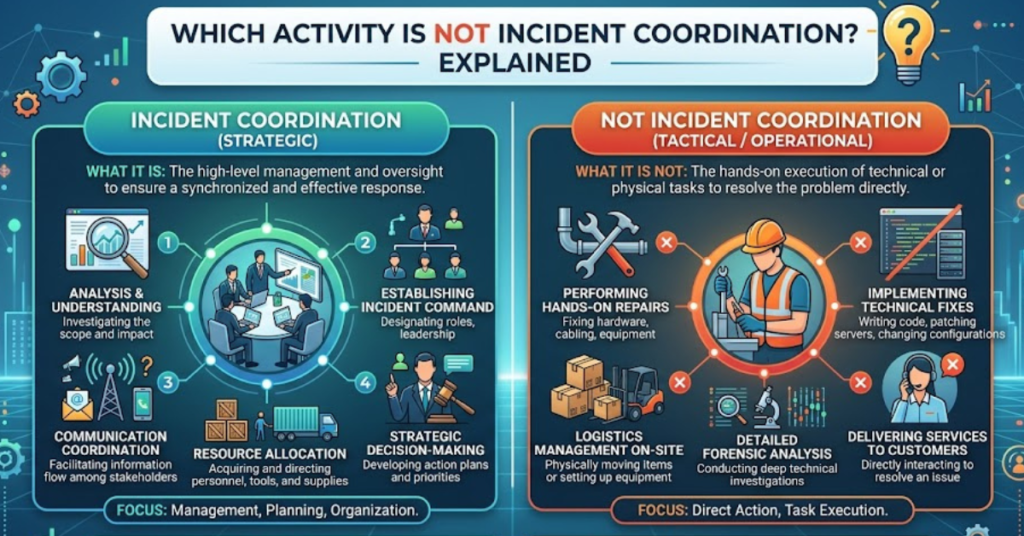
Incident coordination refers to aligning multiple teams, agencies, and resources so they work together effectively during an incident. It focuses on communication, collaboration, and strategic alignment rather than hands-on execution.
Key Characteristics of Incident Coordination
- Sharing information across departments
- Aligning objectives and priorities
- Managing resource requests
- Facilitating communication between agencies
- Supporting decision-making at a higher level
Think of coordination as the traffic controller, not the driver.
Common Examples of Incident Coordination
To understand what is not incident coordination, we first need to see what is.
Activities That ARE Incident Coordination
These are typical coordination tasks:
- Communicating updates between response teams
- Allocating shared resources across departments
- Establishing unified objectives
- Conducting multi-agency briefings
- Supporting strategic planning
All of these involve bringing people together, not doing the operational work.
Which One of the Following Activities Is Not an Example of Incident Coordination?
Here’s the key point:
Direct tactical operations—such as physically extinguishing a fire or performing search and rescue—are NOT examples of incident coordination.
These activities fall under incident response or operations, not coordination.
Example
Let’s say you’re given the following activities:
- Sharing situation updates with partner agencies
- Aligning response priorities across departments
- Deploying firefighters to extinguish a fire
- Managing communication between emergency teams
The correct answer to which one of the following activities is not an example of incident coordination? is:
Deploying firefighters to extinguish a fire
Why? Because this is operational execution, not coordination.
Incident Coordination vs Incident Operations
This distinction often causes confusion, so let’s clarify.
Incident Coordination
- Strategic-level activity
- Focuses on communication
- Aligns resources
- Supports multiple teams
- Happens in coordination centers
Incident Operations
- Tactical-level activity
- Direct action in the field
- Implements response plans
- Handles hands-on tasks
- Managed by operations personnel
In short: Coordination organizes — Operations executes.
Real-World Example
Imagine a large flood affecting several districts:
Incident Coordination Activities
- Emergency operations center sharing updates
- Coordinating evacuation transport
- Prioritizing medical resources
- Communicating with government agencies
NOT Incident Coordination
- Filling sandbags
- Driving rescue boats
- Setting up emergency shelters
- Providing first aid
Those are operational tasks, not coordination.
Why This Distinction Matters
Understanding which one of the following activities is not an example of incident coordination is important because:
- It helps clarify roles in emergency management
- Improves communication efficiency
- Prevents duplication of effort
- Enhances training and preparedness
- Helps in exams and certifications
Clear role separation leads to faster and more effective incident response. 🚑
Quick Tip to Identify Non-Coordination Activities
Ask yourself:
“Is this activity organizing people or directly doing the work?”
- If organizing → Coordination
- If doing → NOT coordination
This simple trick works almost every time.
FAQs
What is incident coordination in simple terms?
Incident coordination is the process of bringing different teams together, sharing information, and aligning actions during an emergency.
Which activity is NOT incident coordination?
Any hands-on operational task, such as firefighting, rescue operations, or medical treatment, is not incident coordination.
Is resource deployment coordination?
It depends. Requesting or aligning resources is coordination, but physically using them is operations.
Why is incident coordination important?
It ensures everyone works toward the same goals, reduces confusion, and improves response efficiency.
Is communication part of incident coordination?
Yes. Communication between teams and agencies is one of the core elements of incident coordination.
Conclusion
Understanding which one of the following activities is not an example of incident coordination comes down to distinguishing between planning and doing. Coordination focuses on aligning teams, sharing information, and managing resources, while operational activities involve direct action in the field.
The next time you encounter this question, remember:
If the activity involves hands-on response, it is NOT incident coordination.
This simple rule will help you answer correctly and better understand incident management principles.