
Mathematics can sometimes feel like a secret code, and one of the most common puzzles students face is understanding which expression is equivalent to another. Whether you’re solving algebra problems or comparing equations, knowing how to identify equivalent expressions is key to mastering math. In this guide, we’ll break it down in simple terms, explore assumptions you might need to make, and provide helpful tips to make it stick.
Understanding Equivalent Expressions
Before diving into examples, let’s clarify what an equivalent expression actually is.
- Definition: Two expressions are equivalent if they have the same value for all possible values of the variables involved.
- Key point: Equivalent expressions may look different but functionally produce identical results.
Example:
2(x+3) and 2x+62(x + 3) \text{ and } 2x + 6
Even though these two expressions look different, they are equivalent because they simplify to the same value for any x.
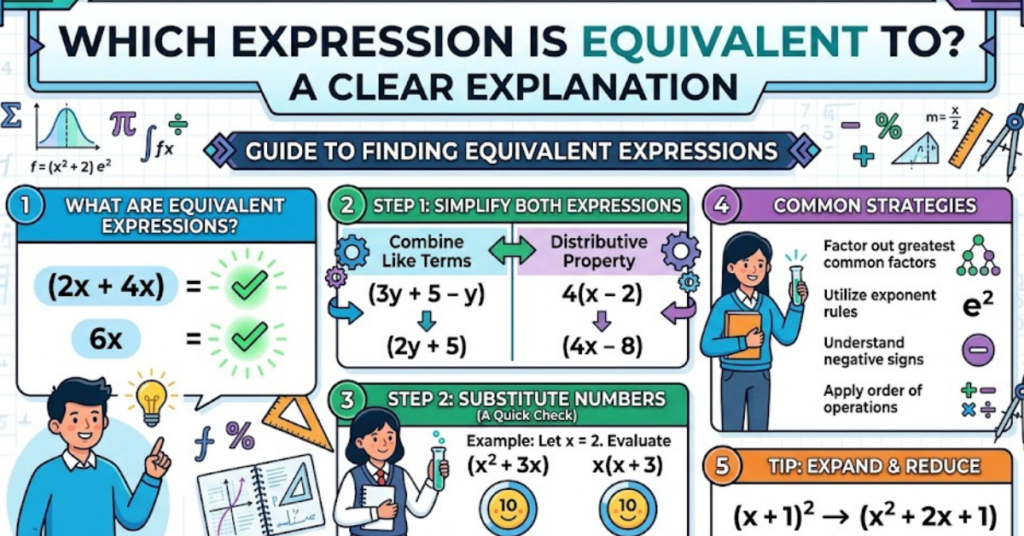
Steps to Identify Which Expression Is Equivalent
Finding equivalence isn’t magic; it’s a process. Here’s a simple method:
- Simplify each expression: Combine like terms and apply the distributive property if needed.
- Substitute values: Test with numbers to see if the expressions yield the same results.
- Factor or expand: Sometimes expressions need factoring or expanding to reveal equivalence.
Tip: Always check multiple values for variables, especially in more complex problems.
Common Assumptions in Equivalence Problems
When solving “which expression is equivalent to?” questions, some assumptions are often necessary:
- Variables are real numbers: Unless stated otherwise, assume x, y, etc., are real numbers.
- Standard operations apply: Addition, subtraction, multiplication, and division follow conventional rules.
- No division by zero: Ensure you never divide by a variable that could be zero.
These assumptions help avoid errors and clarify the solution process.
Examples of Equivalent Expressions
Here are some practical examples:
- Distributive Property:
3(a+4)=3a+123(a + 4) = 3a + 12
Equivalent because multiplication distributes over addition.
- Factoring:
x2+5x=x(x+5)x^2 + 5x = x(x + 5)
Factoring shows equivalence clearly.
- Combining Like Terms:
2x+3x+4=5x+42x + 3x + 4 = 5x + 4
Combining terms simplifies the expression without changing its value.
FAQs
Q1: How do I quickly tell if two expressions are equivalent?
A: Simplify both expressions and test a few values for variables. If results match, they are equivalent.
Q2: Can equivalent expressions have different forms?
A: Absolutely! They may look different but produce the same value for all variable values.
Q3: Do I always need to assume variables are real numbers?
A: Most of the time, yes, unless the problem specifies integers, complex numbers, or another domain.
Q4: What if the expressions involve fractions or exponents?
A: Apply simplification rules carefully—equivalence still holds as long as you respect algebraic rules.
Conclusion
Understanding which expression is equivalent to another is all about recognizing patterns, simplifying carefully, and applying key algebraic rules. By following the steps outlined above and keeping common assumptions in mind, you can solve these problems confidently. Keep practicing, test different values, and soon identifying equivalent expressions will feel second nature.
For more math tricks and guides, explore our related articles on factoring, the distributive property, and simplifying complex expressions.