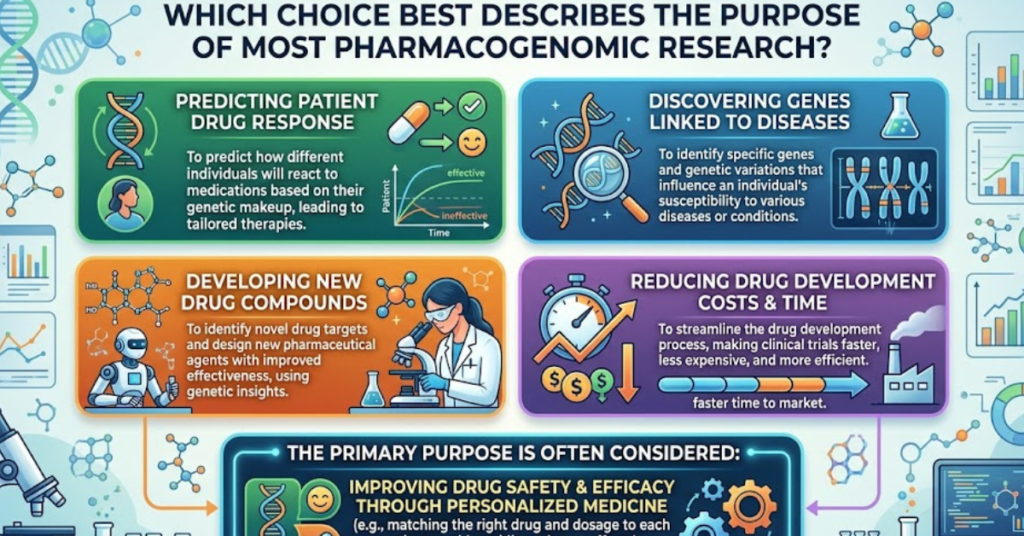

Imagine taking a medication that works perfectly for someone else but causes side effects for you. Why does that happen? The answer often lies in your genes. Understanding which choice best describes the purpose of most pharmacogenomic research helps explain how scientists are working to personalize medicine and improve patient outcomes.
Pharmacogenomics is the study of how a person’s genetic makeup affects their response to drugs. The primary goal is simple yet powerful: to tailor medications to individuals based on their genetic profiles, improving effectiveness while reducing harmful side effects. In this article, we’ll break down what pharmacogenomic research focuses on, why it matters, and how it’s shaping the future of healthcare.
What Is Pharmacogenomics?
Pharmacogenomics combines two major fields:
- Pharmacology – the study of drugs and how they work
- Genomics – the study of genes and their functions
Together, they aim to understand how genetic variations influence:
- Drug metabolism
- Drug effectiveness
- Risk of adverse reactions
- Optimal dosage levels
This field is at the heart of personalized medicine, where treatment decisions are tailored to each individual.
Which Choice Best Describes the Purpose of Most Pharmacogenomic Research?
The best description of the purpose of most pharmacogenomic research is:
To determine how genetic differences among individuals affect their response to medications, allowing for more personalized and effective treatments.
In practical terms, pharmacogenomic research seeks to:
- Identify genetic variations that influence drug response
- Reduce trial-and-error prescribing
- Minimize adverse drug reactions
- Improve treatment outcomes
- Optimize drug dosage for individuals
This focus makes pharmacogenomics a cornerstone of precision medicine.
Why Pharmacogenomic Research Matters
Medication responses vary widely among patients. Some people benefit greatly, others see no effect, and some experience harmful side effects. Pharmacogenomic research addresses this variability.
Key Benefits
- Improved drug effectiveness – Patients receive medications more likely to work
- Reduced side effects – Identifying risk factors before prescribing
- Faster treatment decisions – Less trial-and-error prescribing
- Cost savings – Avoiding ineffective treatments
- Better patient safety – Fewer adverse drug reactions
These advantages highlight why understanding which choice best describes the purpose of most pharmacogenomic research is important for modern healthcare.
How Genetic Differences Affect Drug Response
Your body processes drugs through enzymes, many of which are influenced by genes. Variations in these genes can change how quickly or slowly medications are metabolized.
Common Genetic Effects on Medication
- Poor metabolizers – Drug stays in the body longer, increasing side effects
- Rapid metabolizers – Drug breaks down too quickly, reducing effectiveness
- Ultra-rapid metabolizers – May require different dosing strategies
- Normal metabolizers – Standard dosing typically works well
For example:
- Some antidepressants work differently depending on CYP2D6 gene variants
- Warfarin dosing depends on VKORC1 and CYP2C9 genetic variations
- Codeine effectiveness varies based on metabolism genes
These examples demonstrate how pharmacogenomic research directly impacts prescribing decisions.
Real-World Applications of Pharmacogenomics
Pharmacogenomics isn’t just theoretical—it’s already used in clinical practice.
Areas Where It’s Commonly Applied
- Cancer treatment – Targeted therapies based on tumor genetics
- Cardiology – Personalized blood thinner dosing
- Psychiatry – Antidepressant and antipsychotic selection
- Pain management – Opioid metabolism differences
- Infectious diseases – HIV medication adjustments
These applications show how the core purpose of pharmacogenomic research translates into real-world benefits.
Pharmacogenomics vs. Traditional Medicine
Traditional medicine often follows a “one-size-fits-all” approach. Pharmacogenomics changes that model.
| Traditional Approach | Pharmacogenomic Approach |
| Standard dosing | Gene-based dosing |
| Trial-and-error | Predictive prescribing |
| Higher side effect risk | Reduced adverse reactions |
| Slower treatment optimization | Faster personalized therapy |
This shift highlights why pharmacogenomic research is gaining attention worldwide.
Challenges in Pharmacogenomic Research
Despite its promise, pharmacogenomics faces some hurdles:
- Limited access to genetic testing
- High initial costs
- Need for clinician education
- Ethical and privacy concerns
- Variability across populations
However, ongoing research and technological advances are gradually addressing these issues.
The Future of Pharmacogenomics
The future looks promising. As genetic testing becomes more affordable and accessible, pharmacogenomics may become routine in healthcare.
Expected developments include:
- Personalized prescriptions for most medications
- Integration into electronic health records
- AI-assisted genetic analysis
- Expanded research across diverse populations
- Preventive medicine based on genetic risk
Understanding which choice best describes the purpose of most pharmacogenomic research will become even more important as personalized medicine grows.
FAQs
1. What is the main goal of pharmacogenomic research?
The main goal is to understand how genetic differences affect drug responses so treatments can be personalized for better safety and effectiveness.
2. Which choice best describes the purpose of most pharmacogenomic research?
The best choice is: to tailor drug therapy based on genetic variations among individuals.
3. How does pharmacogenomics improve patient care?
It reduces side effects, increases drug effectiveness, and helps doctors choose the right medication faster.
4. Is pharmacogenomic testing widely available?
It’s becoming more common, especially in cancer care, psychiatry, and cardiology, but availability varies by location.
5. Can pharmacogenomics prevent adverse drug reactions?
Yes. By identifying genetic risk factors, doctors can avoid medications that may cause harmful side effects.
6. Does pharmacogenomics only apply to rare conditions?
No. It applies to many common medications, including antidepressants, painkillers, and blood thinners.
Conclusion
So, which choice best describes the purpose of most pharmacogenomic research? Simply put, it’s to use genetic information to guide medication selection and dosing for safer, more effective treatment. This personalized approach reduces guesswork, improves outcomes, and represents the future of healthcare.
As pharmacogenomics continues to evolve, patients can expect more tailored therapies and fewer unwanted side effects. If you’re interested in personalized medicine, exploring related topics like genetic testing or precision healthcare is a great next step.