
Ever stared at a sentence and wondered when to use semicolon instead of a comma or colon? You’re not alone. The semicolon is one of the most misunderstood punctuation marks, yet it’s incredibly useful when you want your writing to sound polished and clear.
In this guide, you’ll learn when to use semicolon, how it compares to commas, colons, and dashes, and when it’s appropriate in lists or formal writing like the SAT. By the end, you’ll confidently use semicolons without second-guessing yourself.
What Is a Semicolon?
A semicolon (;) connects closely related ideas. It sits somewhere between a period and a comma in strength. Think of it as a “soft full stop” — stronger than a comma but weaker than a period.
When to Use Semicolon Between Independent Clauses
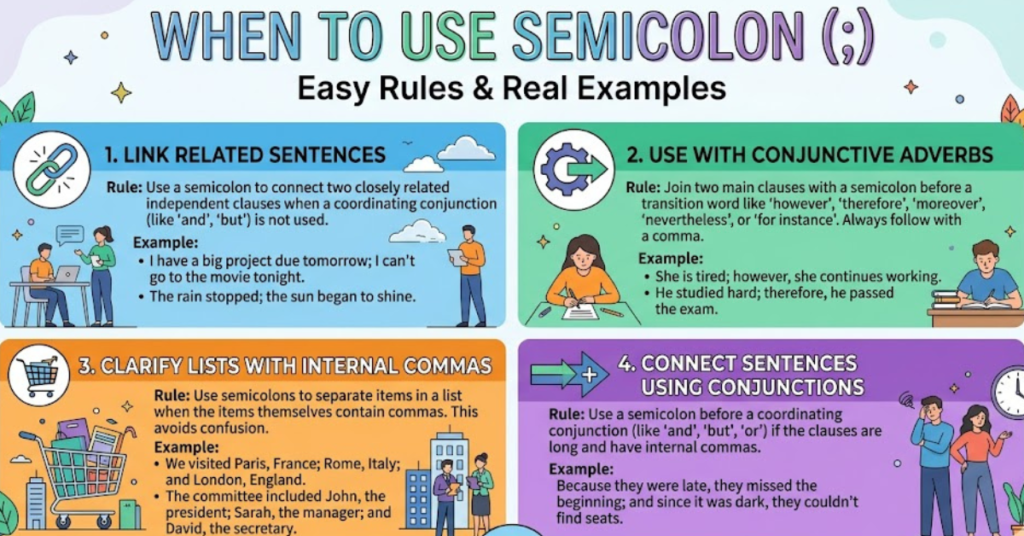
Use a semicolon to join two complete sentences that are closely related.
Example:
- I wanted to go for a walk; it started raining.
- She loves coffee; he prefers tea.
These could be two sentences, but the semicolon keeps them connected.
When to Use Semicolons vs Comma
A comma alone cannot join two full sentences. That creates a comma splice (a common mistake).
Incorrect:
- I finished my homework, I went to bed.
Correct:
- I finished my homework; I went to bed.
- I finished my homework, and I went to bed.
Quick rule:
- Use comma + conjunction OR
- Use semicolon alone
When to Use Semicolons vs Colon
Semicolons connect related ideas; colons introduce something.
Semicolon example:
- The forecast looks bad; we should cancel the trip.
Colon example:
- We need three things: food, water, and blankets.
Easy memory trick:
- Semicolon = link ideas
- Colon = introduce information
When to Use Semicolons in a List
Use semicolons in lists when items already contain commas. This avoids confusion.
Example:
- I’ve lived in Karachi, Pakistan; Dubai, UAE; London, England; and Toronto, Canada.
Without semicolons, the list becomes messy.
When to Use Semicolons and Colon Together
You can use both in complex sentences.
Example:
- She packed everything she needed: clothes, shoes, and toiletries; however, she forgot her passport.
Here:
- Colon introduces the list
- Semicolon connects related clauses
When to Use Semicolons vs Dash
Both connect ideas, but they create different tones.
Semicolon (formal):
- The meeting ran late; everyone stayed patient.
Dash (informal or dramatic):
- The meeting ran late — everyone stayed patient.
Rule:
- Use semicolon for formal writing
- Use dash for conversational tone
When to Use Semicolons SAT Rules
For SAT and academic writing, semicolons are tested often. Remember:
- Join two independent clauses
- Replace conjunctions like “and” or “but”
- Separate complex list items
SAT Example:
- The experiment failed; the team tried again.
If both sides are full sentences, the semicolons is correct.
When to Use Semicolons vs Colon vs Comma Quick Comparison
| Punctuation | Use Case | Example |
| Comma | Separate small ideas | She bought apples, oranges, and grapes |
| Semicolon | Connect related sentences | She was tired; she kept working |
| Colon | Introduce explanation | He had one goal: to win |
Common Mistakes to Avoid
- Using semicolon with incomplete sentences
- Using semicolon before “because”
- Overusing semicolons in short sentences
Wrong:
- I went home; because I was tired.
Correct:
- I went home because I was tired.
Quick Semicolon’s Cheat Sheet
Use a semicolon when:
- Joining related full sentences
- Replacing “and”, “but”, “so”
- Separating complex list items
- Writing formal or academic content
FAQs About When to Use Semicolons
When should you use a semicolons instead of a comma?
Use a semicolon when joining two complete sentences without a conjunction. A comma alone isn’t strong enough.
When to use semicolons vs colon?
Use a semicolon to connect ideas. Use a colon to introduce lists, explanations, or quotes.
Can you use a semicolons before “however”?
Yes.
Example:
- I wanted to go; however, I stayed home.
When to use semicolons in a list?
Use semicolons when list items contain commas to avoid confusion.
Is semicolon’s formal?
Yes. Semicolons are more common in academic, professional, and formal writing.
How do you know if a semicolons is correct?
Check both sides. If both are complete sentences, the semicolon works.
Conclusion
Understanding when to use semicolons can instantly improve your writing clarity and professionalism. Remember: semicolons connect related ideas, organize complex lists, and replace conjunctions in formal writing.
If you’re preparing for exams, writing essays, or creating content, mastering semicolons gives your writing a polished edge. Start using them intentionally, and you’ll notice your sentences flow more smoothly.