
Ever stopped to think about how fast you’re moving right now—without even taking a step? The planet beneath your feet is constantly in motion. If you’ve ever wondered how fast does the earth spin, you’re not alone. It’s one of the most fascinating questions about our planet, and the answer is more surprising than you might expect.
In this article, we’ll break down how fast the Earth spins, how fast the Earth spins around the sun, and why we don’t feel any of it. We’ll keep things simple, accurate, and easy to understand.
How Fast Does the Earth Spin on Its Axis?
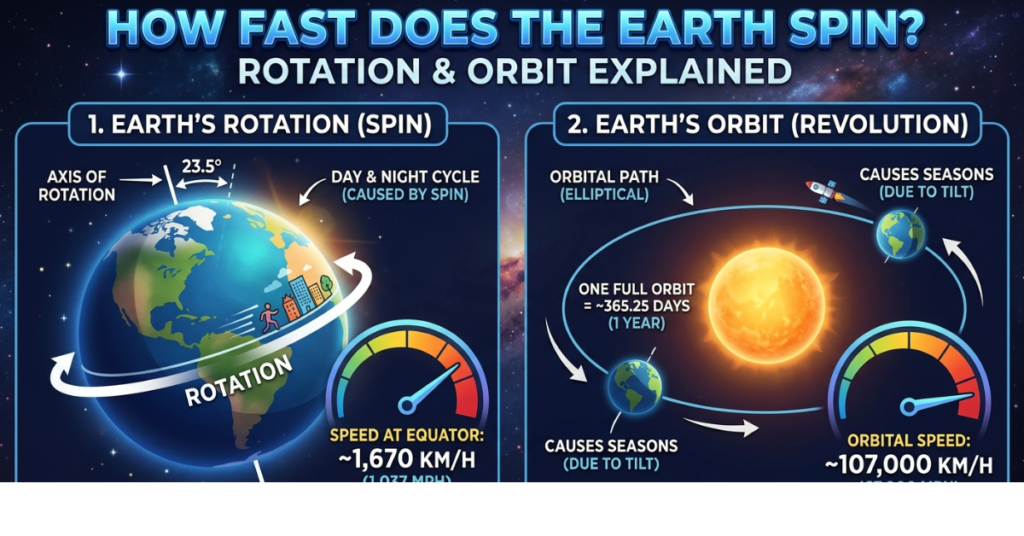
The Earth rotates once every 24 hours. That might sound slow, but when you calculate the distance around the planet, the speed becomes incredible.
At the equator, the Earth spins at approximately:
1,670 kilometers per hour (1,037 miles per hour)
That’s faster than most commercial airplanes.
Why the Speed Changes Depending on Location
The rotation speed isn’t the same everywhere. It depends on your distance from the equator:
- Equator: ~1,670 km/h (fastest)
- Mid-latitudes (e.g., Europe, US): ~1,200 km/h
- Poles: Nearly 0 km/h
This happens because Earth is a sphere. Points closer to the equator travel a larger distance in the same amount of time.
How Fast Does the Earth Spin Around the Sun?
While Earth spins on its axis, it’s also orbiting the sun at an even greater speed.
The Earth travels around the sun at about:
107,000 kilometers per hour 66,600 miles per hour
That’s roughly 30 kilometers per second.
To visualize:
- In one second, Earth moves about the length of three football fields
- In one hour, we travel over 100,000 km through space
And yet, we feel perfectly still.
Why Don’t We Feel the Earth Spinning?
This is one of the most common follow-up questions. If the Earth spins so fast, why don’t we notice it?
Here’s why:
- We’re moving with the Earth at a constant speed
- There’s no sudden acceleration
- Gravity keeps everything anchored
- The atmosphere moves with the planet
It’s similar to sitting in a smooth-moving airplane — you don’t feel motion unless turbulence hits.
Earth’s Rotation vs. Orbit: What’s the Difference?
Let’s simplify:
| Motion | Speed | Time Taken |
| Earth spinning on axis | ~1,670 km/h | 24 hours |
| Earth orbiting the sun | ~107,000 km/h | 365 days |
Both motions happen simultaneously.
Does Earth’s Speed Ever Change?
Yes — but only slightly.
Factors that affect Earth’s rotation:
- Moon’s gravitational pull (tidal forces)
- Earthquakes
- Melting glaciers
- Atmospheric changes
For example, major earthquakes can shorten the day by a fraction of a millisecond.
Fun Facts About Earth’s Speed
- Earth travels 2.6 million km around the sun every day
- The planet spins faster at the equator than anywhere else
- Days are getting slightly longer over millions of years
- The Moon is slowly slowing Earth’s rotation
How Scientists Measure Earth’s Speed
Scientists use advanced tools like:
- Atomic clocks
- Satellite tracking
- GPS measurements
- Laser ranging to the Moon
These methods allow extremely precise measurements of Earth’s rotation and orbit.
FAQs About How Fast the Earth Spins
1. How fast does the Earth spin at the equator?
The Earth spins at about 1,670 km/h (1,037 mph) at the equator.
2. How fast does the Earth spin around the sun?
Earth orbits the sun at approximately 107,000 km/h (66,600 mph).
3. Does the Earth spin faster than it orbits the sun?
No. The orbit around the sun is much faster than Earth’s rotation.
4. Why don’t planes feel the Earth spinning?
Because the atmosphere moves with Earth, planes and passengers already share the same rotational speed.
5. Is the Earth’s spin slowing down?
Yes, very slowly. The Moon’s gravity is gradually reducing Earth’s rotation speed.
Conclusion
So, how fast does the earth spin? The answer is astonishing — up to 1,670 km/h at the equator. And when you include how fast the Earth spins around the sun, we’re actually moving through space at 107,000 km/h.
Even though we don’t feel it, we’re constantly traveling at incredible speeds. Understanding these motions helps us appreciate just how dynamic our planet really is.
Want to learn more? Explore related topics like:
- Why Earth has seasons
- How gravity works
- What would happen if Earth stopped spinning