
Understanding triangle congruence is essential in geometry, and the SAS (Side-Angle-Side) rule is one of the most commonly used methods. If you’ve ever wondered which pair of triangles can be proven congruent by SAS, you’re in the right place. This article will break it down in a simple, conversational way so you can grasp it clearly.
What Is the SAS Rule?
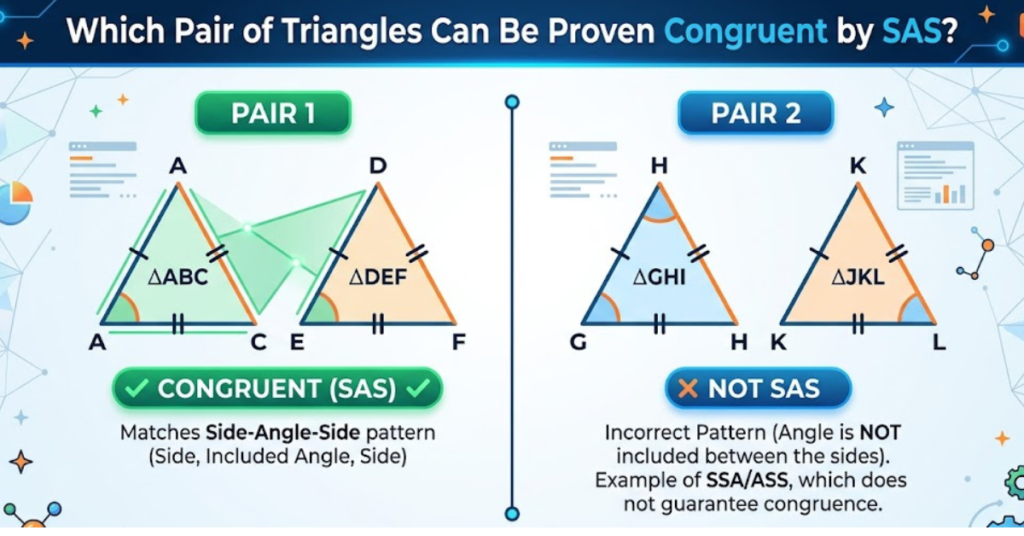
The SAS rule states that if two sides and the included angle of one triangle are exactly equal to two sides and the included angle of another triangle, the triangles are congruent.
Here’s a quick breakdown:
- S = Side of a triangle
- A = Angle between two sides
- S = Another side of the triangle
In simpler terms, if you know two sides and the angle between them are identical in two triangles, you can confidently say the triangles are congruent.
How to Identify SAS in Triangles
When checking for congruence using SAS, keep these points in mind:
- Two Sides Must Match: Measure or compare two sides from each triangle.
- The Included Angle Must Match: Ensure the angle is between the two sides, not outside.
- Check Correspondence: Make sure the sides and angle correspond correctly between the two triangles.
Example:
Imagine triangle ABC and triangle DEF:
- AB = DE
- AC = DF
- ∠A = ∠D (angle between the two sides)
Here, triangles ABC and DEF are congruent by SAS. Simple, right?
Common Mistakes to Avoid
Many students misapply SAS. Avoid these pitfalls:
- Wrong Angle: The angle must be between the two sides, not adjacent.
- Non-corresponding sides: Make sure you’re comparing the correct sides of each triangle.
- Assuming without measurement: Always verify equality, don’t guess.
Why SAS Works
SAS works because knowing two sides and the included angle locks the shape of a triangle. Once these three elements are fixed:
- The third side is automatically determined.
- The triangle cannot change its shape.
- This guarantees congruence.
Think of it like assembling a three-legged stool: once two legs and the connecting angle are fixed, the third leg automatically fits.
Real-Life Applications of SAS
SAS isn’t just for textbooks. It’s surprisingly practical:
- Engineering & Construction: Ensures triangle supports are congruent for stable structures.
- Navigation & Surveying: Helps calculate unknown distances and angles.
- Art & Design: Artists use congruent triangles to maintain symmetry in designs.
FAQ Section
Q1: Can any two triangles be proven congruent by SAS?
A: Only if two sides and the included angle of one triangle match the other exactly.
Q2: Is SAS the only way to prove triangle congruence?
A: No, other methods include SSS (Side-Side-Side), ASA (Angle-Side-Angle), and AAS (Angle-Angle-Side).
Q3: What does “included angle” mean?
A: It’s the angle formed between the two sides you’re comparing, not outside the sides.
Q4: Can SAS be applied to right triangles?
A: Yes! Right triangles often use SAS because one angle is 90°, making it easy to check congruence with two sides.
Conclusion
So, which pair of triangles can be proven congruent by SAS? It’s the pair where two sides and the included angle match perfectly. By following the SAS rule carefully, avoiding common mistakes, and understanding the principle behind it, you can confidently identify congruent triangles in any scenario.
Next step: try drawing a few triangles and applying SAS yourself—it’s the best way to see the rule in action!