
Look up at the sky on a bright afternoon and it’s hard not to wonder: how far away is the sun? It feels close enough to warm your skin, yet it’s actually separated from Earth by an enormous distance. Understanding this distance helps explain everything from seasons to space travel and even why sunlight takes time to reach us.
In this guide, we’ll break down the distance in miles, compare it with Mars, and explain why the number isn’t always the same. By the end, you’ll have a clear, easy-to-understand picture of our place in the solar system.
How Far Away Is the Sun From Earth?
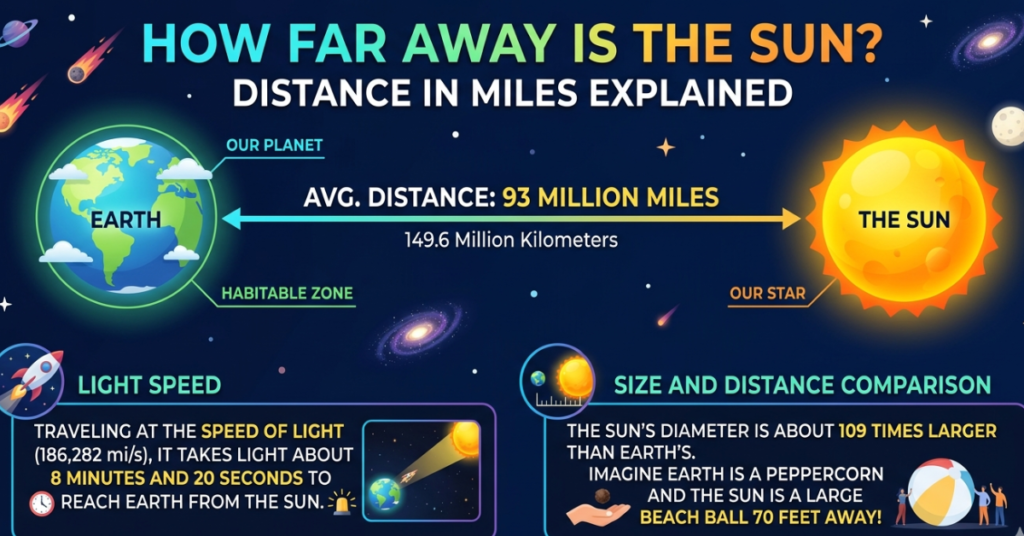
On average, the sun is about 93 million miles (150 million kilometers) away from Earth. Scientists call this distance one astronomical unit (AU), which is used as a standard measurement in space.
However, Earth’s orbit isn’t perfectly circular. That means the distance changes slightly throughout the year:
- Closest point (Perihelion): ~91.4 million miles
- Farthest point (Aphelion): ~94.5 million miles
So when someone asks how far away is the sun in miles, the most accurate answer is about 93 million miles on average.
How Long Does Sunlight Take to Reach Earth?
Even at the speed of light, sunlight isn’t instant. It takes approximately:
- 8 minutes and 20 seconds for sunlight to reach Earth
- Light travels at about 186,282 miles per second
This means when you see the sun, you’re actually seeing it as it looked over eight minutes ago. Pretty mind-blowing, right?
How Far Away Is the Sun From Mars?
Mars orbits farther from the sun than Earth, so the distance varies more dramatically. On average:
- Mars is about 142 million miles (228 million km) from the sun
- At closest: ~128 million miles
- At farthest: ~155 million miles
This greater distance explains why Mars is colder and receives less sunlight than Earth.
Why the Distance to the Sun Changes
The distance isn’t fixed because planets travel in elliptical (oval-shaped) orbits. Several factors influence this:
- Gravitational pulls from other planets
- Orbital speed changes
- Tilt of planetary axes
Despite these variations, the average distance remains consistent enough for scientific calculations.
Fun Comparisons to Understand the Distance
Numbers like millions of miles are hard to visualize, so here are some relatable comparisons:
- Driving at 60 mph nonstop: ~177 years to reach the sun
- Commercial airplane: ~20 years of continuous flight
- Light speed: 8 minutes 20 seconds
- Spacecraft (Parker Solar Probe): Still takes months
These examples show just how vast space really is.
Key Facts About the Sun’s Distance
- Average distance: 93 million miles
- Light travel time: 8 minutes 20 seconds
- Distance varies slightly each year
- Mars is significantly farther from the sun
- Scientists measure distance using astronomical units
FAQs
How far away is the sun in miles exactly?
The average distance is about 93 million miles, though it varies slightly due to Earth’s elliptical orbit.
Does the distance to the sun change?
Yes, Earth moves closer and farther during the year, but the change is relatively small.
How far away is the sun from Mars compared to Earth?
Mars averages about 142 million miles from the sun, making it much farther than Earth.
Why don’t we feel the distance if the sun is so far away?
Because the sun is extremely large and emits massive amounts of energy, enough to reach Earth even across vast space.
How do scientists measure the distance?
They use radar, orbital mechanics, and astronomical units to calculate solar distances precisely.
Conclusion
So, how far away is the sun? On average, about 93 million miles from Earth, and even farther from Mars. While that distance sounds enormous, it’s perfectly balanced to support life on our planet. Too close, and Earth would overheat. Too far, and everything would freeze.
Understanding this distance gives you a new appreciation for the delicate balance of our solar system. Next time you step outside on a sunny day, remember—you’re feeling warmth from a star nearly 93 million miles away.